


Biological adoption in the U.S. has a storied history, with many farmers citing reliability and effectiveness frustrations with the first generation of ag biologicals. Armed with a $12 million seed round, Chicago-based IMIO has a solution to this reliability issue with the technology behind its crop residue management product, which is helping farmers save money on nutrients and tilling expenses.
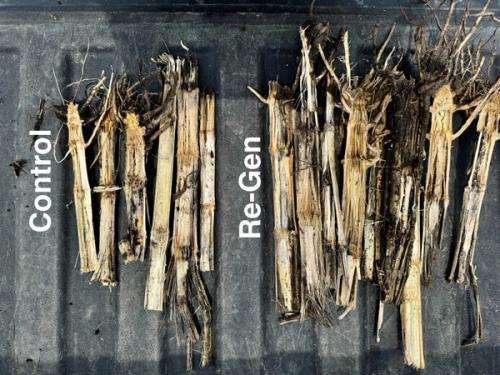
Founded in 2019, IMIO (Infinite Microbes, Infinite Opportunities) bio-manufactures Re-Gen, a granular treatment for crop residue that uses microbes to break down lignin and cellulose in crop residue, helping release nutrients into plant available forms, founder and CEO Charles Smith told AgNavigator. Re-Gen is registered as a bio-stimulant in all 50 states and available in a row crop and produce version.
By breaking down the nutrients in crop residue, farmers can reduce their fertilizer needs while increasing yields, he added.
Farm trials on more than 10,000 Midwest acres in 2024 and 2025 found that Re-Gen increased the average corn yield by 11.9 bushels per acre and nutrient credits of up to $120 per row crop acres, the company reported. Additionally, farmers saved $120 per produce acre in tillage expenses.
IMIO will use the seed funding to build out its team and complete construction of its Chicago headquarters, which is expected to be completed in Q2 of 2027, Smith noted. The seed round was led by Sofinnova Partners with contributions from Chipotle’s Cultivate Next venture fund, Earth Foundry, Grow Together Salinas, Serra Ventures, and Starshot Capital.
Initially located in Vermont, IMIO moved to Chicago to be closer to the grain belt and tap into the pool of talent inside the city and Illinois, he said. This comes as IMIO is gaining market traction, having sold to over 100 customers, as the biotech company prioritizes scaling production in the U.S. before expanding into other markets, he added.
“We’ve been able to demonstrate meaningful traction in multiple markets, and I think there’s a lot of enthusiasm among our customers and our investors and our team about the way we can address this reliability challenge for biologicals,” Smith emphasized.
Solving biologicals’ major adoption challenge: Reliability
While biological awareness has grown in the U.S., many farmers still have lingering concerns around reliability, stemming from many of the first generation of bio-based inputs not fully delivering intended benefits.
“The reality of biologicals versus chemical inputs is that it is naturally a more complex equation. You’re trying to impact the growth of living organisms, the plants, with other living organisms, the microbes, and then soil in the middle of it is an incredibly complex and variable substrate,” Smith elaborated.
IMIO has solved this challenge through lyophilization, a process that freeze-dries microbes, allowing them to be shipped in a shelf-stable powder, Smith explained. By using this process, IMIO can deliver “about 100,000 times more active microbes than other biological products,” boosting the effectiveness and reliability of the product, the company shared in a press release.
“One of the reasons that you hear farmers express concerns about reliability is that far too many of them use biological products that were dead before they sprayed them. Microbes are really powerful, but you’re not going to get as much value out of the dead microbes,” he elaborated.

