

Corteva says the performance of its precision-bred soybean trial in Warwickshire has exceeded expectations, providing some of the strongest evidence yet that soybeans could become a viable commercial crop in the UK.
The trial, hosted at the company’s Wellesbourne Research Station, demonstrated how gene editing can help soybeans flower and mature much earlier than conventional varieties, overcoming one of the biggest barriers to growing the crop successfully in Britain’s cooler climate.
Gene editing delivers “beyond expectation” results
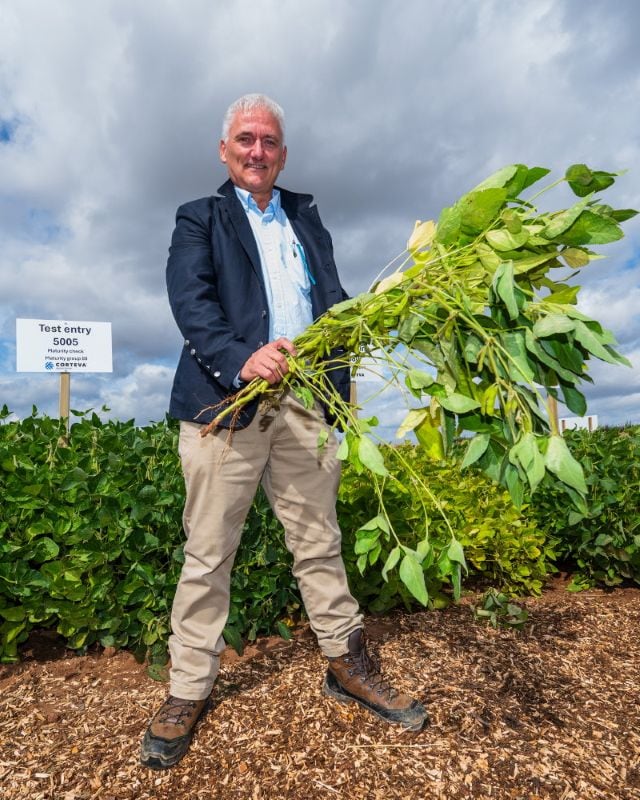
According to Dr Frank Röber, Corteva’s Europe Breeding Alliances Lead, the impact of the edits was visually obvious even to non-specialists visiting the site.
“It was very obvious how good the gene edits worked,” he told AgNavigator. “For me, because it was the first time to see the gene edits in Europe, it went beyond expectation.”
The trial represents the culmination of a five-year proof-of-concept project conducted in collaboration with French research institute INRAE. Remarkably, much of the initial gene editing work was carried out by a PhD student, Manon Monfort, underlining the accessibility of the technology compared with some more resource-intensive breeding approaches. “You don’t need 40 or 50 scientists to do this kind of gene editing work,” Röber pointed out.
Turning an Italian soybean into a British soybean
At the heart of the breakthrough is Corteva’s ability to alter the crop’s flowering behaviour.
Soybeans are classified into maturity groups that determine where they can be grown successfully. The starting genetic material used in the trial belonged to Maturity Group 3, varieties typically suited to southern European growing regions such as Italy and far too late-maturing for UK conditions.
Commercial soybean production in Britain would typically require varieties in the much earlier 00 or 000 maturity groups.
Yet through editing just three flowering suppressor genes, Corteva was able to shift the crop’s maturity by two to three maturity groups.
“We were jumping two to three maturity groups by editing only three genes,” Röber explained.
The result surprised researchers. One of the trial lines in which only three genes had been edited actually matured significantly earlier than another line containing five edits, highlighting both the power of the technology and the need for continued research into how individual genes influence crop development.
The flowering network in soybean is already well understood, with scientists having identified 11 flowering suppressor genes. By selectively “switching off” specific suppressors, breeders can activate earlier flowering without disrupting much of the plant’s existing genetic makeup.
Field performance offers compelling proof of concept
For Corteva, the most convincing evidence came not from laboratory data but from what was happening in the field.
Röber described how the gene-edited plants were visibly ahead of conventional material, with pods already fully developed and plants beginning the natural senescence process.
“The interesting point was that this early gene-edited variety had fully filled pods, while the conventional variety had little pods,” he said.
“That gene-edited variety had already started to senesce, which is normal. I was super pleased about the outcome. It was so obvious.”
Although UK regulations currently prevent the company from taking the crop all the way through to harvest and producing viable seed, the visual differences observed during the trial provided strong evidence that the maturity challenge can be addressed through precision breeding.
The next stage is to assess final maturity and yield performance through multi-location trials in the United States across five test sites.
While early flowering alone is not enough to guarantee commercial success, Corteva believes the results strongly suggest that high-performing soybean genetics can be adapted for northern growing environments far more efficiently than through conventional breeding alone.
Why soy matters for the UK
The commercial opportunity is significant.
Despite soy’s importance to global food and feed systems, UK soybean production remains tiny. Around 2,000 hectares were grown in Britain in 2019, but acreage has since fallen dramatically.
At the same time, the country imports millions of tonnes of soybeans and soy products each year to feed livestock.
“You are importing millions of tonnes of soybeans to feed your pigs and your cows,” Röber said. “So there’s a demand for soybean.”
Developing a domestic soybean sector could therefore improve supply chain resilience while helping farmers diversify rotations.
Soybeans also bring agronomic advantages. Like other legumes, they fix atmospheric nitrogen, reducing fertiliser requirements at a time when nitrogen costs remain a major concern for growers. Röber also highlighted the crop’s positive contribution to soil health.
The UK already grows substantial areas of other protein crops, including peas and fava beans, suggesting soy could potentially find a place within existing arable systems if climate and maturity barriers can be overcome.
Gene editing offers a faster route than conventional breeding
Traditionally, breeders seeking to adapt soybean varieties to northern climates would cross high-yielding late-maturing varieties with earlier types and then spend years selecting offspring that combine both traits.
Gene editing offers a far more targeted approach.
“What we typically create are early-by-late crosses and we try to move performance from late types to earlier types,” Röber said.
“With gene editing, we can make a late, good-performing variety early.”
The key advantage is that breeders can modify the genes controlling flowering time while leaving most of the crop’s yield-related genetics untouched.
For Corteva, this offers an opportunity not simply to create earlier soybeans, but to transfer the productivity potential of elite southern European genetics into northern environments much more quickly and accurately than conventional breeding methods allow.
UK regulation gives innovation a head start
Although the framework for commercial marketing and cultivation of precision-bred crops is a separate step preventing unapproved precision-bred material from entering the food, feed or commercial seed supply, the trial also serves as an early test case for the UK’s Precision Breeding Act, which Corteva believes gives British agriculture a competitive advantage.
According to Röber, running the experiment at Wellesbourne was relatively straightforward under the UK’s regulatory framework.
“We were really very pleased. That was a very straightforward project,” he said.
The same trial would not currently have been possible under existing EU legislation governing gene-edited crops, although Brussels is progressing its own New Genomic Techniques (NGT) framework.
Röber believes the UK is currently ahead in creating a practical environment for precision breeding research.
“The regulation we have in the UK works very well,” he said. “You just have to send a letter to Defra, tell them the plan you have and then you can make the test.”
As the UK and EU move towards closer cooperation under a forthcoming SPS agreement, the trial highlights the innovation benefits currently enabled by Britain’s regulatory flexibility.
A glimpse of UK agriculture’s future?
While Corteva acknowledges that commercial soybean production in Britain is still some way off, the Wellesbourne trial offers an encouraging glimpse of what may be possible.
For Röber, soybeans demonstrate a broader principle: precision breeding can help crops adapt to new environments and tackle challenges ranging from climate change to disease pressure.
“I think soybean really demonstrates a wider principle,” he said. “Precision breeding can help crops adapt to changing environments and address specific production constraints.”
For now, the trial remains a research project. But by successfully transforming a southern European soybean into a plant capable of maturing far earlier under British conditions, Corteva has taken a significant step towards answering a question that would have seemed improbable only a few years ago: could soy become a commercially viable crop in the UK?
Based on the evidence emerging from Wellesbourne, the answer appears increasingly likely to be yes.


