


On Nov. 12, John Deere, alongside partners Penske Truck Leasing, Chevron, and Optimus Technology, gathered at its North American parts distribution center in Milan, Illinois, to reveal a collaboration to bring biodiesel-powered trucks to the original equipment manufacturer’s (OEMs) fleet as part of a broader renewable fuel initiative.
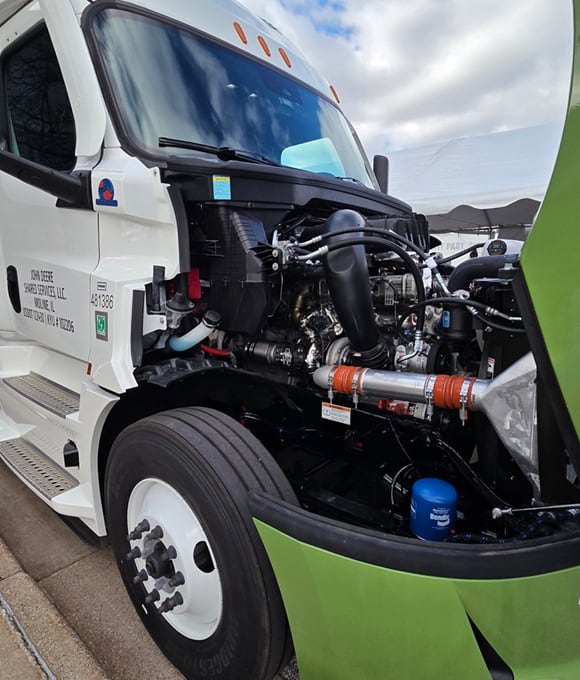
Through a six-month pilot, John Deere’s fleet will operate five 2027 Freightliner Cascadia trucks with Optimus’ patented Vector System, allowing trucks to run either on traditional diesel or biodiesel. These trucks will transport parts from the facility in Milan to other John Deere warehouses and dealerships along pre-determined routes.
Optimus’ technology consists of a two-fuel tank system, one for biodiesel and another for traditional diesel, along with software and electronic controllers that monitor the biodiesel, explained Optimus’ CEO Colin Huwley during the event.
When a driver starts the vehicle, the traditional diesel will heat up the biodiesel tank, and once the biodiesel hits a certain operating condition, the system switches over to 100% biodiesel (B100), Huwley explained. In cold weather, biodiesel begins to gel, which is addressed from the traditional diesel heating up the biodiesel tank, he added.
Before shutting down, the engine will be flushed with traditional diesel to ensure biodiesel does not remain in the engine and fuel injectors, Huwley noted.
“One of the critical aspects of the technology is that it never inhibits the engine from operating on traditional diesel, and this is immensely important for trucks that have real-world tasks to do,” Huwley elaborated.
John Deere will start with five trucks but then take learnings from the pilot program to bring more biodiesel trucks and the technology to more fleets and locations, John Deere’s Director of Biofuels Nate Green told AgNavigator.
“We invested a lot of money in the technology to upgrade [these trucks]. We want to keep them in service for the full three-to-five-year useful life of a normal Class A semi-truck. If all goes well, we’re also going to look at expanding the project, including to other geographies where we have similar defined routes and where infrastructure makes sense,” Green elaborated.
John Deere leans into biofuel innovation
This biodiesel partnership is the latest in a string of biofuel investments and innovations from the green-and-yellow ag equipment maker under a broader renewable fuel initiative ─ a project Green leads.
He explained that the renewable fuel initiative is built on three pillars: demonstrating leadership by expanding renewable fuels in equipment and operations, broadening the coalition through collaborations and projects, and advocating for policy to support biofuels.
John Deere is also working to develop tractors that run on biofuels, with the OEM running four prototype ethanol tractors in the U.S. and having tested a tractor with B30 in the summer, Green noted. Additionally, John Deere continues its work to test equipment that runs on biofuels in places like Brazil, AgNavigator reported previously.
Also, John Deere is working to advance policy that will support the growth of the biofuel industry, Green noted. The U.S. mandates biofuel blending rates through the National Renewable Fuel Standard, with a mandate to produce 8.86 billion gallons of biomass-based fuel by 2026.
Following decades of slow expansion, the U.S. soybean crush complex grew roughly 25% between 2020 and 2025, growing a crucial component of the biofuel capacity, Green explained. However, biodiesel is not readily available at gas stations across the U.S., hence why John Deere had to establish pre-determined routes for the five trucks with Optimus’ technology.
John Deere expects to drive the five trucks more than 700,000 miles annually, which equates to 85,000 gallons of B100, supplied from Chevron’s biodiesel plant in Seneca, Illinois, which produces the fuel from soybean oil and distillers corn oil.
“It’s really important to demonstrate what’s possible and to show demand in specific use cases to enable those national blend levels to go up. And that includes on the feedstock side having enough feedstock to supply increasing utilization and blending of renewable fuels,” Green said. “The more demand that we can demonstrate and to incorporate into fleet usage, the easier it is to utilize, and push up those blend levels on a national level.”
What biofuels mean for Illinois farmers
The agricultural industry can benefit from biofuels in two ways, providing a stable domestic market for row crops like soybean and offering relief from high diesel prices that are hurting farming margins. After reaching a peak of $6.529 a gallon on Sept. 21, 2026, diesel prices have moderated some to around $6.127 on Nov. 9, according to U.S. Energy Information Administration data.
While soybean farmers started the year primarily concerned about fertilizer prices, “it has all turned to fuel costs,” Kevin Johnson, director of government relations and strategy, told AgNavigator. The Illinois Soybean Association advocates for policies to promote biofuel usage, both at the federal and state level.
Illinois offers a biodiesel tax credit for blending biodiesel at a 20% rate (B20), which eliminates the normal 6.25% sales tax that would apply to traditional diesel, saving consumers approximately $0.40 a gallon, Johnson noted. The Illinois biodiesel tax credit is in effect until December 2030, which the Illinois Soybean Association is advocating to extend, he added.
The Illinois Soybean Association continues to advocate for the use of the crop in a range of different markets and applications, and the organization is working to promote the John Deere and Optimus partnership and what’s possible with biodiesel.
“We are helping to promote Optimus. With John Deere and other companies using this technology, this leads the way for others down the road to look at this,” Johnson said. “They’re going to use five vehicles, but long term more vehicles are going to 100% biofuel.”


