

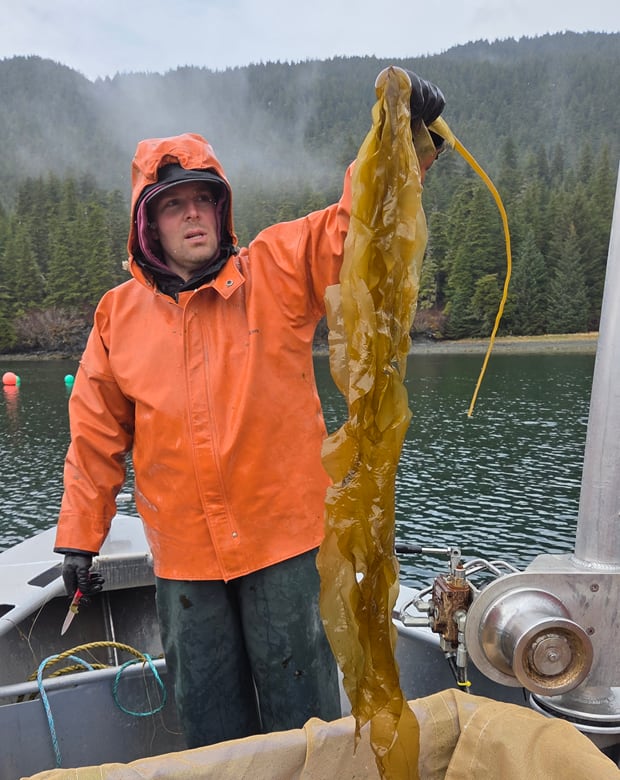
Off the southern and southeastern coast of Alaska, a cluster of kelp farmers is working to establish the state’s next big crop – which is being used as a sustainable food source, a valuable biostimulant, and a nutraceutical – creating opportunities for local and rural communities impacted by declines in fishing.
Alaska began commercial kelp farming around 2017 with roughly 20 kelp farms in operations today through a state permitting process. These farms harvested 240,000 pounds of seaweed in 2025, compared to 155,000 pounds in 2024, as seed quality improved and two additional hatcheries went online, according to a 2025 report from The Alaska Mariculture Cluster.
One of Alaska’s biggest markets for kelp is biostimulants, with companies like Cascadia Seaweed, Pacific Kelp Co., Kachemak Kelp, and others offering various products to improve crop health. The global seaweed biostimulant market is projected to grow to $1.876 billion by 2030, second only to the nutraceutical market at $3.954 billion, according to a global seaweed report from The World Bank.
Over the years, Alaska’s fishing industry faced a series of setbacks, propelling interest in other mariculture goods. A combination of rising input costs and lower prices for every species resulted in direct losses of $1.8 billion from 2022 to 2023 and $4.3 billion in total U.S. output losses, according to a NOAA report.
Alaska’s nascent kelp industry is helping to diversify the state’s agricultural production and complement the fishing sector, Jason Lessard, executive director at the Alaska Mariculture Alliance, told AgNavigator on a visit to Cordova, Alaska, hosted by public relations firm Tastemaker Comms.
“We’ve always felt that the mariculture industry and our fish industry can really work pretty symbiotically — that the seasons are opposite one another. ... It’s another way to keep some year-round ocean work going for folks,” Lessard elaborated.
Down on the kelp farm
Kelp planting takes place in October and harvest in early May, whereas the salmon fishing season starts in the middle of May and ends in September, Lessard pointed out.
“Getting the seed in the water by October is really important. ... If you outplant in January, it’ll still grow. It just isn’t going to have the same biomass and yield,” Sean Den Adel, co-owner of kelp farm Noble Ocean Farms, said on a visit to his farm.
Located in Simpson Bay, Alaska, Noble Ocean Farms is operated by Adel and his wife, Skye, who grow sugar and bull kelp for use in the food and ag input markets.
One of the kelp farm’s largest customers is Cascadia Seaweed, which is buying 50,000 pounds of kelp from Noble Ocean and other kelp farms across Craig, Kodiak, and Prince of Wales in Alaska for use as a liquid biostimulant, Adel noted. Additionally, Noble Ocean Farms sells its kelp to Blue Dot Kitchen, which uses the seaweed for its Seacharrones snack brand, he added.
Navigating tricky logistics in Alaska
Alaska is proving it can produce kelp, but the challenge comes from processing the crop and shipping it to the end buyer.
Currently, farmers are taking their kelp, chemically stabilizing the plant to ship “wet and really heavy” in totes or drying the kelp through a process that involves a screw press and industrial driers, he added. Noble Ocean Farms is also experimenting with salting the kelp, Adel noted.
“We know we can grow it. It’s just a matter of what we do with it after we grow. What stage of processing does it need to get to for the ultimate buyer?” Lessard emphasized.
Like their terrestrial counterparts, kelp farmers are feeling the same pains from higher diesel prices, since they take boats to their farms on the water, complicating operating margins and harvesting logistics. The farms closer to town and port are naturally at an advantage, Lessard explained.
“You have to go out and tend your farm, so you’re burning fuel every time you’re going out, whether the crop is going to be good or not. And so closer to town is great. We do have more coastline than all of the rest of the US. We don’t necessarily have communities in the area that make it accessible with [a lot of] ease, but there’s a lot of room to still grow,” Lessard elaborated.
Providing kelp farmers tools for success
Logistics is just one part of developing a new industry. Researchers and scientists are another crucial part and provide farmers with insight on how best to grow crops.
The Prince William Sound Science Center in Cordova conducts research on how best to grow kelp and maintains a kelp hatchery, where farmers can pick up seeds, Angela Korabik, a mariculture postdoc at the center, told AgNavigator.
Adult kelp reproduces by releasing spores that germinate into female and male gametophytes, which then release eggs and sperm to create a kelp sporophyte.
Prince William Sound Science Center collects the sorus tissues – the parts of the plant that release spores – and then applies it to sea strings, which are then wrapped around a PVC pipe for farmers to use, Korabik explained. Last year, the center produced 55,000 feet of seed line of sugar, bull, ribbon, and giant kelp, she added.
Shipping the live tissue raises concerns around the spool or tissue being damaged, which could impact yields, Korabik noted. Thus, the Prince William Sound Science Center is located where farmers in Cordova can easily pick up spores and release it on their farms, she said.
“Having something available in town for farmers – where all they have to do is pull up to the dock, drive 10 minutes down the road, drop off their tissue or pick up their tissue, drive 10 minutes down the road, get on the boat and cut out – it cuts down on shipping costs, and it increases the likelihood that the quality of the spools created in the hatchery is going to be that same exact quality when they get out planted on the farm,” Korabik elaborated.
Alaska’s kelp industry faces an uncertain future
Alaska’s kelp – and oyster – sector is supported through a $49 million Build Back Better Regional challenge grant that the Alaska Mariculture Cluster received in 2022 under the Biden administration to bolster the state’s sustainable mariculture industry.
“The Build Back Better challenge grant has been a tremendous asset, and it’s really helped to progress developing the industry,” Lessard emphasized.
However, $49 million is not enough money to fully support the development of Alaska’s kelp or oyster industries, Lessard explained. The grant funding is split into different obligations, including $15.889 million for equipment and technology, $9.331 million for a revolving loan, $9.283 million for workforce development, and other obligations.
“We’d have three times that and still there would be a lot of work,” Lessard acknowledged.

