

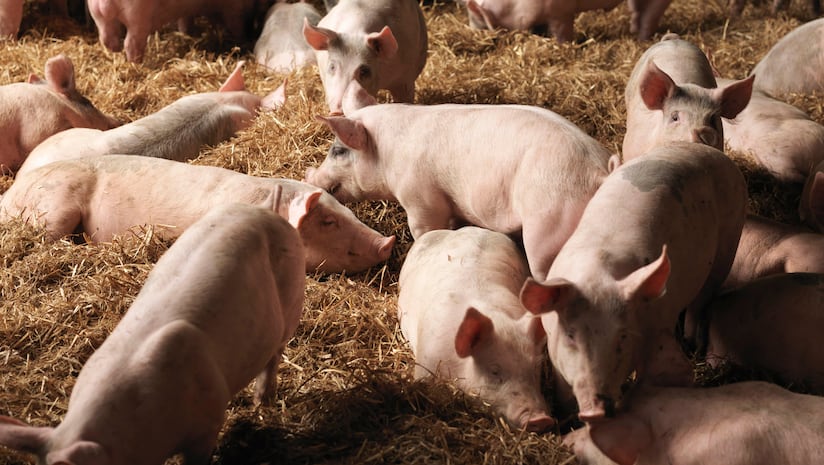
- China is prioritising AI as pork consumption peaks.
- Livestock output topped 175 million tonnes in 2025.
- The plan targets greater value, safety, and sustainability.
The Ministry of Agriculture and Rural Affairs (MARA) recently issued the National Livestock and Veterinary Industry Development Plan.
“The plan clearly states that by 2030, the high-quality development of animal husbandry will reach a new level, with a more stable and secure supply of major livestock and poultry products and a greater improvement in the industry’s overall quality,” a MARA official told reporters.
The plan proposes 15 quantitative targets but notably does not set a growth target for total meat production.
Officials said the decision reflects changing market realities in pork production.
“No incremental target has been set for total meat production. This mainly reflects a new supply-and-demand landscape characterised by the rapid improvement in overall pig production capacity and pork consumption having largely reached its peak.”
At the same time, this move is intended to “guide the pig industry’s transition from quantity-driven growth to high-quality development”, rather than focusing purely on increasing production.
Smart farming focus
The new plan places greater emphasis on technology, productivity and industry modernisation.
Among the five key tasks outlined in the plan is a commitment to strengthen technological capabilities across the livestock sector, including “accelerating the application of artificial intelligence and the development of smart livestock farming”.
AI tools are increasingly being deployed across global livestock production for applications ranging from disease detection and animal health monitoring to feeding optimisation, breeding management and farm automation.
China’s Muyuan Group relies on AI to improve animal welfare and optimise resource use across its extensive farming operations.
As the world’s largest pork producer, the company views technology as essential for managing production at scale, AgNavigator reported.
This push towards AI comes as China’s livestock industry records unprecedented output levels.
In 2025, China’s combined output of meat, eggs and milk exceeded 175 million tonnes, remaining above 170 million tonnes for the third consecutive year.
Total meat production surpassed 100 million tonnes for the first time.
Meanwhile, industrialised farming has become the sector’s dominant production model.
According to MARA, the national scale-farming rate reached 76.9%, driving widespread adoption of advanced technologies and equipment.
Science and technology accounted for 70% of growth in the livestock sector, while the comprehensive utilisation rate of livestock manure exceeded 80%.
Shifting gears
Over the next five years, policymakers will focus increasingly on improving productivity and value creation.
“This includes stabilising the production of major livestock and poultry products, cultivating and promoting superior livestock and poultry breeds, developing high-quality and distinctive livestock and poultry industries, expanding the forage industry, improving the processing and distribution level of livestock and poultry products, and strengthening livestock brand building,” said the official.
The plan calls for further optimisation of the industry’s structure and broader ecosystem.
“The role of large enterprises in linking and leading farmers will be further strengthened, the profit distribution mechanism will be gradually improved, the upstream and downstream industrial ecosystem will be more coordinated, and the development quality of small and medium-sized farms will be significantly improved.”
The plan also aims to strengthen disease prevention and control across the livestock sector.
It targets higher food safety standards and lower veterinary antibiotic use per unit of livestock production, while promoting greener farming practices.


