


The UK Agri-Tech Centre has selected two homegrown innovators, Breedr and Biotangents, to join its 2026 Global Growth Accelerator (GGA) Australasia programme, sending them to New Zealand to validate their technologies on commercial farms and build pathways to international expansion.
The initiative is designed to move companies beyond innovation and into practical, on-farm adoption by connecting them with global markets, commercial partners and production systems where technologies can be tested, proven and scaled.
For both companies, the focus is on addressing two critical priorities for global livestock and dairy production: improving productivity through better data and strengthening animal health through rapid diagnostics.
Why New Zealand matters
Central to the programme’s strategy is New Zealand’s role as a globally recognised benchmark for livestock and dairy production – a testing ground where technologies must prove both technical performance and real-world usability.
“New Zealand provides a powerful proving ground to demonstrate their value in one of the world’s most respected livestock and dairy markets,” said Steve McLean, CEO at the UK Agri-Tech Centre.
Breedr’s UK & EU country manager, James Wright, echoed that view, highlighting the country’s unique mix of environmental conditions and commercial pressure.
“New Zealand is one of the best farming countries in the world,” he told AgNavigator. “It punches out of its weight class, exporting to countries across Asia and Europe. If our technology works here, it shows that we can support some of the globe’s best and most productive farmers.”
With its grass-based systems, export-driven sector and strong farmer focus on efficiency, New Zealand offers a high bar for validation – one that resonates with global buyers and supply chains.
The move also reflects wider concerns about the UK’s ability to scale agri-tech innovation domestically. As previously reported by AgNavigator, industry stakeholders have pointed to a persistent “scale gap” between early-stage innovation and widespread commercial adoption, with comparisons often drawn to more coordinated ecosystems such as the Netherlands (read more: UK looks to Dutch model to fix agri-tech scale gap).
Against this backdrop, programmes like the GGA Australasia are increasingly seen as a way for UK companies to generate the real-world validation and market traction needed to accelerate growth – even if that means proving their technologies overseas first.

From innovation to adoption
A key challenge for agri-tech companies is not simply creating technology but ensuring it works in real farming conditions and is adopted by farmers.
“In farming, just having technology that solves a problem isn’t good enough,” said Wright. “You need to show that farmers are willing and able to use it, in the wind, rain and heat.”
Breedr’s trials will be designed to demonstrate exactly that. Already used by thousands of farmers across the UK and US to manage livestock data and performance, the company will test whether its platform can achieve similar uptake across New Zealand’s diverse farming regions.
“Our trial in New Zealand will show that our technology, loved by farmers in Britain and America, will be equally used by those in New Zealand from the top of Auckland to the hills of Southland,” Wright added.
This emphasis on usability and adoption is at the heart of the GGA model, which embeds companies directly within local farming systems to generate commercially relevant evidence – not just technical results.
Validating animal health solutions in a global benchmark market
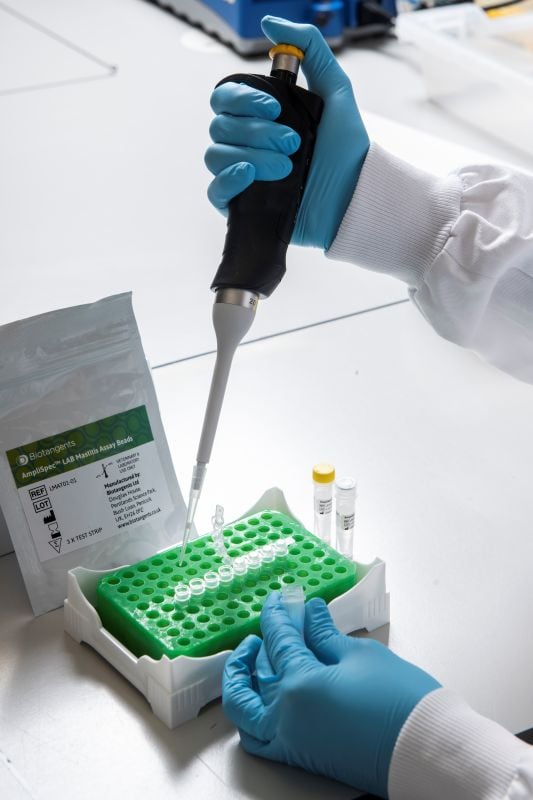
For Edinburgh-based Biotangents, the opportunity lies in testing its rapid diagnostic technology, AmpliSpec™ Mastitis, within one of the world’s most advanced dairy sectors.
“New Zealand’s dairy industry sets the benchmark for global animal health standards,” said Ivonne Robledo, head of operations at Biotangents.
“Bringing AmpliSpec™ Mastitis to New Zealand means delivering fast, pathogen-specific diagnostics where they’re needed most – at the farm, in real time, when treatment decisions can’t wait.”
By trialling in a market known for high production efficiency and strict health standards, Biotangents aims to demonstrate both the technical reliability and commercial relevance of its offering.
Building pathways to global markets
Delivered in partnership with Agnition Ventures – the innovation arm of Ravensdown farmer co-operative – and AgriTech New Zealand, the programme goes beyond field trials.
Participants gain exposure to local supply chains, stakeholder networks and commercial partners, allowing them to co-develop pilots tailored to the needs of the market.
By doing so, the GGA seeks to reduce barriers to adoption while generating the evidence needed to secure customers and investors in export markets.
“UK agri-tech has enormous potential, but innovation only creates impact when it is adopted in the real world,” said McLean. “Our role is to help businesses bridge that gap.”
From Fieldays to farm deployment
The programme’s momentum has been building in recent weeks, with the UK Agri-Tech Centre promoting the initiative at Fieldays – New Zealand’s largest agricultural event – through engagements with farmers, industry participants and members of the UK’s Environment, Food and Rural Affairs (EFRA) Committee.
The next phase begins in July, when Breedr and Biotangents will travel to New Zealand to commence pilot deployments, working directly with commercial farms and local partners.

